


Two Days, Eight Sessions, and a Cleaner View of the Export Landscape
June 18–19, 2026 | Hotel Quality Inn Residency, Nampally, Hyderabad
FIEO Hyderabad's two-day certificate programme on export opportunities — June 18 and 19 — was a well-run edition. Eight sessions, a strong institutional speaker lineup across government, logistics, and finance, and enough depth in most sessions to make the time genuinely productive.
Sri R. Kulkarni, Head, Telangana Chapter, FIEO, opened proceedings. Coordinating a programme of this scope — DGFT, RBI, ECGC, Customs, NALSAR, IIP, India Post, and a senior logistics practitioner all in the same two-day room — takes more behind-the-scenes effort than is visible from the attendee side. It showed in the quality of what was delivered.
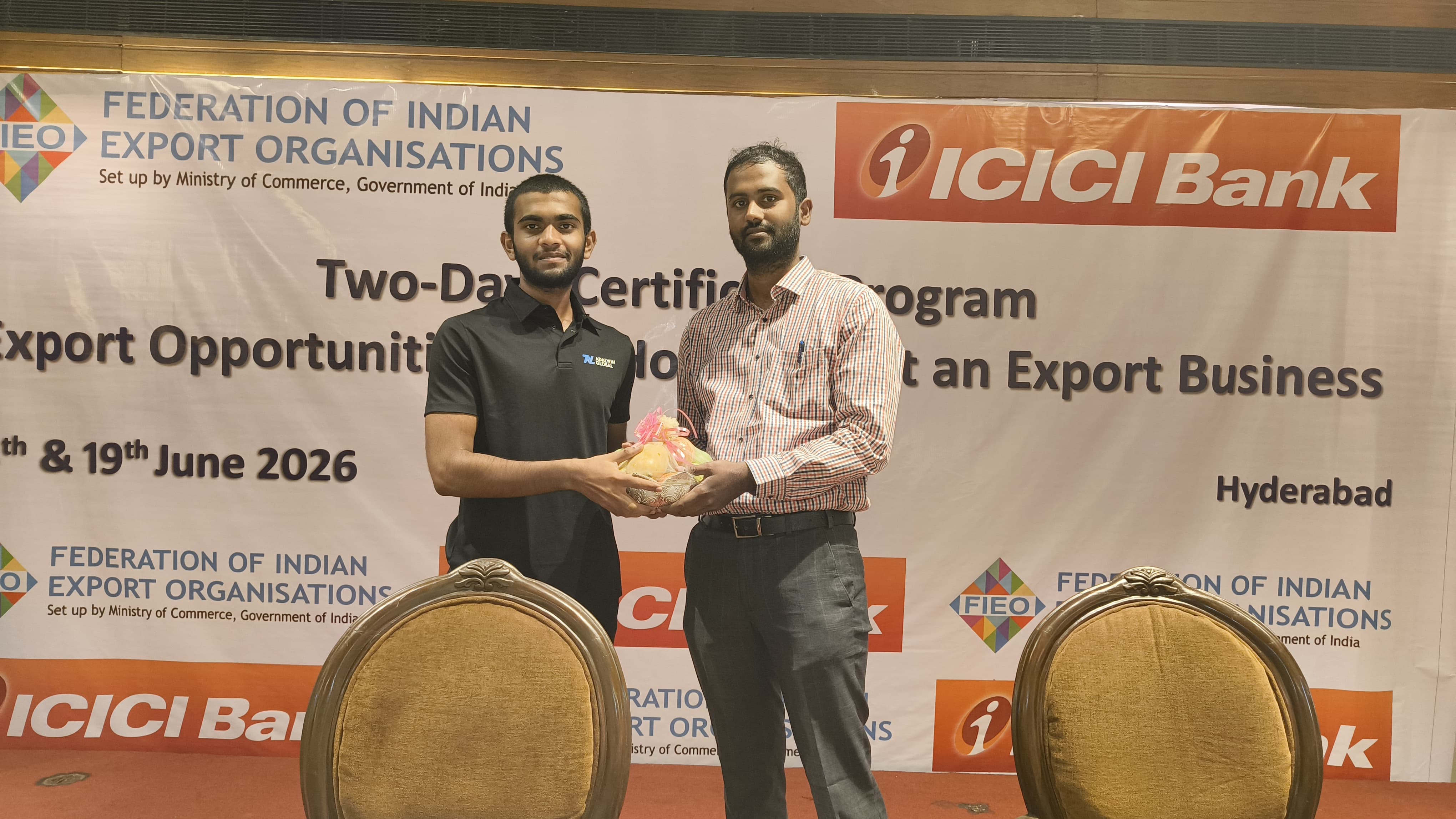 Vickram K Reddy (Adalwin Global) presents the welcome memento to Sri Sai Teja Reddy Velamuri, Manager – FED, Reserve Bank of India, Hyderabad
A special moment: I was part of a felicitation where we honoured Sri Sai Teja Reddy Velamuri, Manager – FED, Reserve Bank of India, Hyderabad, representing Adawin Global. Later, he went on to deliver one of the most practically relevant sessions of the two days. Adalwin Global is FIEO-registered and part of this ecosystem — so being in the room for these programmes is as much about staying current as it is about building the network.
Export Documentation & Customs Clearance — Sri Kamal Jain, Director, Cargomen Logistics (India) Pvt. Ltd., Day 2
This was the standout session across both days. Twenty-seven years in customs handling and freight forwarding produces a clarity about what actually happens at ports — as opposed to what the regulations say should happen — that no theoretical session can replicate.
Stuffing vs. Sealing are two steps that many exporters conflate. Stuffing is loading goods into a container and moving it to the nearest CFS (Container Freight Station) or ICD (Inland Container Depot) for customs clearance — this can be done at the factory or at the CFS/ICD. Sealing is a separate step requiring a Customs officer's physical supervision: the officer checks documents and goods, then affixes the customs seal. Factory sealing is possible, but restricted to AEO-certified exporters.
Before calling a freight forwarder, have these ready: mode of transport, port of loading, port of discharge, weight, volume, product description, HS code, and any specific instructions. Calling with this information ready signals you are there to do business. The terms you get — rates, attention, follow-through — reflect how that conversation is positioned.
On product classification and prohibitions: items that are freely importable into India are not automatically freely exportable. Infrared cameras are an example — importable, not exportable. Filing customs documentation for a prohibited export is itself an offence, regardless of whether the shipment was attempted. Checking product status on DGFT's trade portal before committing to any order is non-negotiable.
On what to do when an importer's licence expires at the destination: if a consignment arrives and the importer's import licence has lapsed — UAE has active licensing requirements, for instance — customs will not release it. Two paths: the importer renews the licence and clears the goods, or the exporter works with the shipping line to issue a Delivery Order (DO) against the Bill of Lading to redirect the consignment to a new buyer from the bonded warehouse. The second option requires a willing alternative buyer and liner cooperation. Operationally possible — but entirely avoidable through pre-shipment due diligence on the buyer's compliance status.
The session also walked through the stakeholder web in full: CHAs, freight forwarders, custodians (CONCOR, GMR, DIAL, Adani and others), surveyors, and Participating Government Agencies (Plant Quarantine, Animal Quarantine, CDSO, Texprocil). Understanding who is responsible for what at each stage changes how you coordinate across the logistics chain rather than assuming your freight forwarder covers everything.
Credit Risk Management in International Trade — Sri Amit Kumar, AGM & Branch Head, ECGC Limited, Hyderabad, Day 2
Sri Amit Kumar framed ECGC specifically from a risk management perspective — which made familiar material more useful than a standard product walkthrough.
ECGC covers political and commercial risk: buyer insolvency, protracted default, contract breach, LC revocation, import restrictions due to economic crisis, war-related disruptions, and government interventions. It does not cover quality disputes, exchange rate fluctuation, or losses arising from the exporter's own failures. Those two categories are the exporter's responsibility to manage. Everything else is insurable.
The non-payment claim process has a specific, time-sensitive sequence: when payment falls due and is not received, you wait 30 days from the due date, then file a non-payment notification (Overdue Declaration) with ECGC by the 15th of the following month. Concurrently, a 4-month cooling-off period begins ticking from the original due date. If payment has still not arrived by the end of those 4 months, you are eligible to file a formal claim. Upon submission of all required documents and claim acceptance, you will receive reimbursement for the covered percentage (usually 80-90%) of the invoice value within 45–60 days.
One nuance around destination-country restrictions: if a country imposes a compliance benchmark on a product category — say, a specific quality requirement for rice — and you export without knowing about the prior notification, a rejection at customs for non-compliance falls outside ECGC coverage. However, if the restriction was imposed after your export documentation was filed — goods already in transit when the regulation changed — coverage applies. The timing of the regulatory change relative to your shipment date is the determining factor. Knowing your destination market's active notifications before every shipment is not optional.
Dun & Bradstreet provides credit reports and buyer risk assessments — useful for pre-shipment due diligence. D&B provides analysis, not coverage. ECGC is the only mechanism that actually covers the loss.
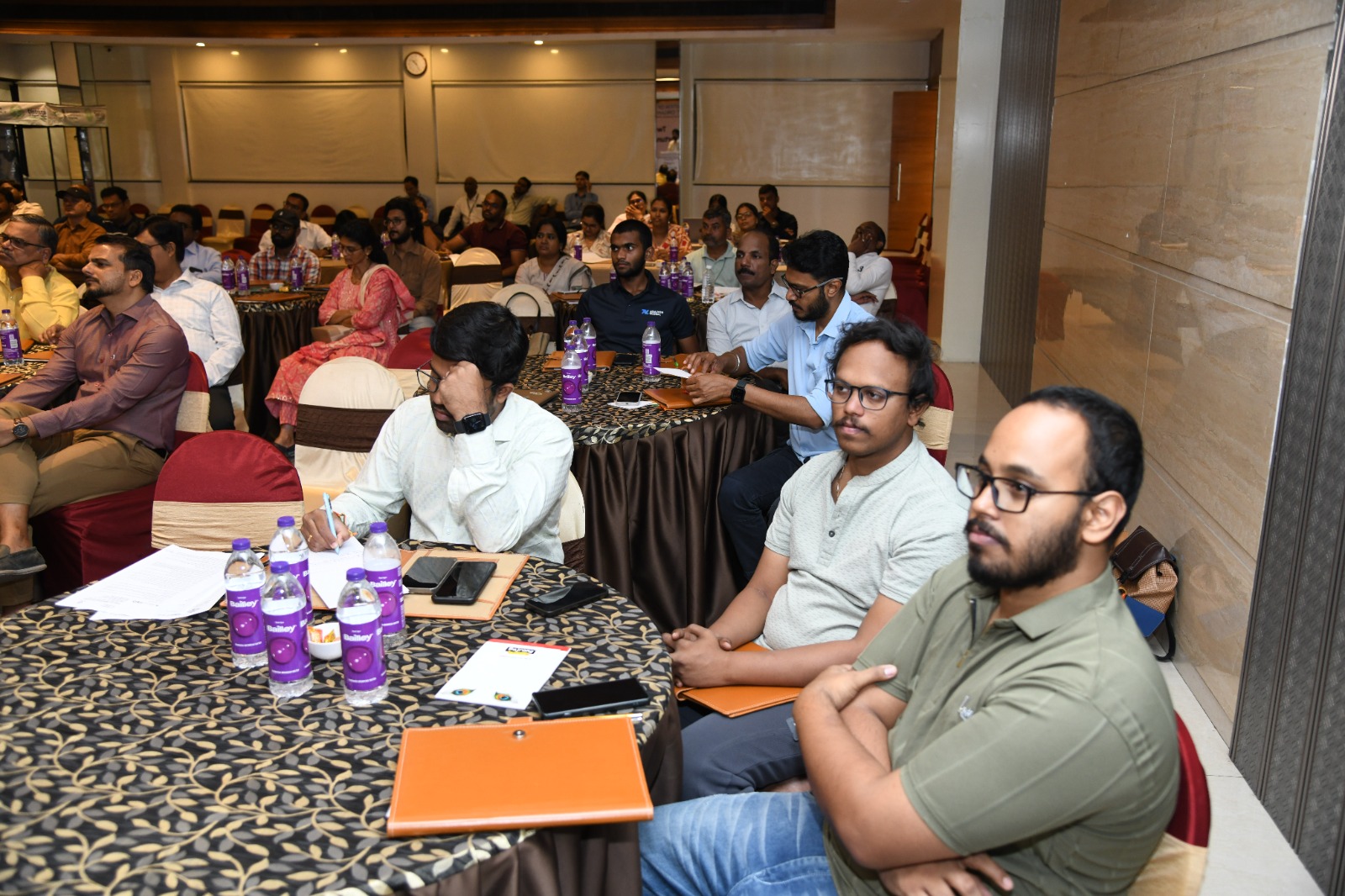 Attendees listening intently during Sri Amit Kumar’s presentation on International Credit Risk Management.
FEMA Regulations & RBI Compliance — Sri Sai Teja Reddy Velamuri, Manager – FED, Reserve Bank of India, Hyderabad, Day 2
Sri Sai Teja walked through the FEMA framework for export transactions — EDF obligations, AD bank reporting, and the realisation timelines that shape every export on non-advance payment terms.
The key update came through notification FEMA 23(R)/(7)/2025-RB dated November 13, 2025: the standard realisation period for export proceeds has been extended from 9 months to 15 months, reflecting the volatility in global trade conditions. If realisation does not happen within 15 months, a further 12-month extension is available from the Authorised Dealer bank. Beyond that, an additional 12-month grace period applies — but if proceeds remain unrealised, the exporter is restricted to advance payment terms for all future exports until the matter is resolved.
For manufacturers exporting against advance inward remittance: goods must be shipped within 3 years from the date the advance was received. If shipment is not possible, the advance must be repatriated to the buyer. There is no ambiguity in the regulation on this point.
The same notification also extended the validity of export declarations under Regulation 15 from one year to three years — a practical improvement for exporters managing longer fulfillment cycles.
This is compliance that directly affects cashflow decisions and bank relationships. Getting it wrong is not a paperwork issue; it affects your ability to export on standard payment terms going forward.
Export Promotion Mission — Sri Akshay S.C., ITS, Joint Director General of Foreign Trade, Day 1
The DGFT session covered India's Export Promotion Mission — ₹25,060 crore outlay across FY2025-26 to FY2030-31, structured around two sub-schemes: Niryat Protsahan (trade finance access) and Niryat Disha (non-financial barriers — standards compliance, logistics costs, market intelligence, and overseas warehousing).
On Niryat Protsahan, the practical point: a 2.75% interest subvention on pre- and post-shipment export credit, capped at ₹50 lakhs per exporter, applied for via dgft.gov.in. For MSMEs carrying working capital on export credit, that reduction in interest cost is a direct improvement in pricing competitiveness. Collateral guarantee support is available in partnership with CGTMSE — 85% coverage for Micro and Small exporters, 65% for Medium, capped at ₹10 crore per exporter per year.
Beyond finance, the DGFT introduced the Trade Connect ePlatform (trade.gov.in) — consolidating Trade Agreements and Tariff Explorer, EXIM Paathshaala (19 export-focused courses in six Indian languages), Product Guide, Country Guide, and an Ask-an-Expert function that routes queries to government officers, EPCs, and Indian Missions Abroad. Worth bookmarking if you haven't already.
I came in aware of most of the foundational DGFT infrastructure. What's different with this edition of the programme is the pace of implementation — the Trade Connect consolidation and the EPM credit mechanisms are operational now, not aspirational. The direction is right, and the speed has improved.
FTAs & Recent Developments — Dr. Rosmy Joan, Director, Centre for International Trade and Business Laws, NALSAR University of Law, Day 2
This session came with a timely backdrop — the India-UK CETA, signed in July 2025, was formally announced as entering into force on July 15, 2026, on the very morning of Day 1 of this programme. For textile exporters: the 12% import duty on textiles into the UK is eliminated under the agreement. Zero duty on approximately 99% of India's exports to the UK. That changes the competitive pricing equation directly, and Indian textile stocks reacted accordingly on June 18.
Dr. Rosmy Joan covered the typology of trade agreements — MFN, PTA, FTA, CEPA, CECA — and went into depth on Rules of Origin, which is where FTA benefits either materialise or don't.
Signing an FTA opens a door. Rules of Origin determine whether your specific product is eligible to walk through it. The frameworks that apply: Value Addition, Change in Tariff Heading (CTH), Specific Processing Rules, De Minimis (proportion of foreign material capped by commercial value, with percentages set by the importing country), and Cumulation — which allows raw materials from an FTA partner to count as local content in certain agreement structures.
Diagonal Cumulation extends this further: if India exports garments made from Chinese yarn to South Korea, and India-China, China-Korea, and India-Korea FTAs are all in place with a "sharing of materials" clause, the Chinese yarn can be treated as local material for origin purposes. This operates actively in EU regional trade frameworks; its relevance to India's expanding FTA network is growing.
India now has nine FTAs spanning 38 countries — UAE CEPA (May 2022), Australia ECTA (December 2022), EFTA TEPA (in force October 2025), India-UK CETA (in force July 15, 2026), India-Oman CEPA (December 2025), India-New Zealand FTA (December 2025), India-EU FTA (January 2026), and the India-US interim trade framework (February 2026). The pace of agreement activity in the last eighteen months has been meaningful.
This session is theory-heavy by nature. Understanding Rules of Origin at this level isn't optional background knowledge — it determines whether a specific market entry strategy is financially viable, and it shapes supply chain choices that have to be made before the order is confirmed.
Export Packaging & Labelling Standards — Sri N. Nataraj, Deputy Director & Regional Officer, Indian Institute of Packaging, Hyderabad, Day 1
Most exporters understand packaging in general terms — protect the product, communicate the brand. What this session made clear is that export packaging operates at a different level of specificity: altitude pressure in airfreight, moisture migration during ocean transit, compression stacking strength in containerised cargo, chemical interaction between material and product.
What stayed with me more than any technical slide was watching Sri Nataraj review a fellow participant's actual product packaging in real time. He identified structural weaknesses that aren't visible unless you know what to look for, and suggested eco-friendly alternatives without being prescriptive. That kind of direct, problem-specific engagement is the reason to attend in person rather than read a guide.
Product Selection, Market Research & Finding Buyers — Dr. V.B.S.S. Koteswara Rao, CEO, Global Exim Institute, Hyderabad, Day 1
Dr. Koteswara Rao covered product selection usiang the PNR Framework — Product (what's on your mind), Network (what's available through your connections), Region (what your geography naturally produces). Secondary filters follow: seasonal vs. non-seasonal, commodity vs. value-added, price volatility, perishability, restrictions in target country. A structured way to narrow a product shortlist quickly.
Two things from the session stood out. First: the suggestion to contact the Indian Embassy or Trade Commissioner in your target country and schedule a meeting before you travel, whether the trip is for business or personal. Ground-level market intelligence that no portal replicates. Second: the India-USA Trade Connect Portal as a specific tool for US market buyer access — requires IEC, EPC membership, and Chamber of Commerce registration.
GST Basics & GST Refund for Exporters — Sri D. Sri Nagesh, IRS, Assistant Commissioner of Customs, Hyderabad GST Commissionerate, Day 2
The GST session covered types of supply, zero-rated status for exports and SEZ supplies, IGST refund claims, and the relationship between Duty Drawback and IGST refund. Both can be claimed on separate components; double-claiming on the same element is not permitted.
This was technically dense. Having attended a good number of export-focused sessions before this, the concepts were easier to connect in context than they might have been earlier. Some content lands differently once it has a framework to sit inside — this was one of those sessions.
Dak Ghar Niryat Kendra (DNK) — Sri Putta Ravinder, Marketing Executive, Secunderabad Division, Department of Posts, Day 2
The DNK session was a useful reminder that India Post is a genuinely viable channel for sample shipments and small-value consignments. For exporters spending thousands on private courier players based on volumetric weight calculations, India Post's rates are significantly lower — EMS up to 35kg, Air Parcel up to 20kg — with direct customs integration via auto-generated PBE numbers and digital LEO. The platform handles IGST refund triggering automatically. Onboarding requires IEC, GSTIN, and AD code linked to ICEGATE; the AD code registration inside ICEGATE is consistently the step that delays setup, so sort that first.
Export Finance — Sri Ch. Raju, Regional Head, ICICI Bank Ltd., Hyderabad, Day 2
The export finance session covered standard pre- and post-shipment credit facilities, PCFC, and LC-backed financing. The content was broadly familiar — the mechanisms of export finance from a bank perspective haven't changed structurally. Useful to have a senior banker in the room for specific queries, and a few participants made good use of that access.
Role of FIEO's Services — Sri R. Kulkarni, Head, Telangana Chapter, FIEO, Day 2
Sri Kulkarni closed the programme with a walkthrough of what FIEO offers operationally: Status Holder recognition, Certificate of Origin issuance (non-preferential), visa recommendation letters for trade travel, document attestation, Indian Trade Portal access, trade fair participation support, and the FIEO Indian Business Portal in partnership with Globallinker. For exporters in Telangana, the chapter is the most direct access point for all of these.
What I'm Taking Forward
I came into this programme having covered most of the foundational material before. What two days in a room with government officers, logistics veterans, regulatory specialists, and other exporters produces is something different from reading the same content independently.
Kamal Jain's documentation session was the clearest reminder of that. Twenty-seven years of freight forwarding experience doesn't reproduce itself in any guidebook. The ECGC risk session reframed coverage I already understood — from "what ECGC offers" to "what can actually go wrong, and exactly when the coverage applies or doesn't."
And beyond the formal sessions: the peer-to-peer conversations in between. People approaching the same export challenges from different products, different markets, different stages — that exchange produces the kind of specific, real-world clarity that no speaker slot can replicate. Networking in these rooms is one of the primary reasons to show up in person.
A sincere thanks to Mr. R. Kulkarni, Head, Telangana Chapter, FIEO — and the entire FIEO Hyderabad team — for making this happen well. That level of organisational effort is what makes a programme like this actually worth attending.
— Vickram, Adalwin Global vickram@adalwin.com